France’s Never-Ending Wars Against Islām
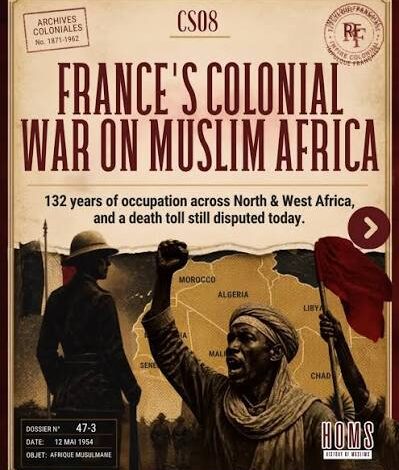
About the French hatred for Islām and the systematic targeting of Muslim lands, pens can never go dry. There is much — far too much — to write and record through the annals of our history, from the colonial onslaughts of the nineteenth and twentieth centuries down to the present day. What appears as scattered episodes of “pacification,” “civilising mission,” or “security cooperation” reveals, from the perspective of the Muslims who endured them, a continuous pattern: the elimination of religious leadership, the destruction of populations that resisted, the desecration of sacred spaces, and the enduring extraction of resources that still fuels French power while leaving Muslim societies impoverished and scarred.
In 1917, during the occupation of Chad, French colonial forces carried out the infamous Coupe-Coupe (or Kubkub) Massacre in Abéché. Under the pretext of consulting local notables, they gathered Muslim scholars and Fuqahā. At dawn after Sub’h, colonial troops ambushed them and beheaded scores — estimates range from dozens to as many as 150 or more in local memory — with machetes. The heads were displayed in rows at the entrance to the district. The intent was clear: by eliminating the ‘ulamā’, the French sought to leave the Muslim community leaderless, cut off from its religious and intellectual guidance, and thus more easily subordinated to foreign civilisation. Similar targeting of scholars occurred elsewhere in the Sahel, including reports of massacres in Agadez. The survivors fled or saw books of the Ulamā that defined Our civilisation dumped into wells or carted away to France. This was not isolated brutality; it was policy aimed at breaking the spiritual backbone of Muslim resistance and obliterate the Civilisation of Islam. So they aimed…
When French troops entered the Algerian oasis city of Laghouat in December 1852, under General Aimable Pélissier, the assault turned into days of massacre. Approximately two-thirds of the population — between 2,500 and 3,600 out of roughly 4,500–6,000 inhabitants, including women, children, and the elderly — were killed. Bodies were piled in the streets like barricades and thrown into wells (one well alone received over 250 corpses). Survivors later recalled the “year of emptiness” (ʿĀm al-Khalya) and the “year of Hessian sacks,” when living men and boys were bound in sacks and thrown into trenches.
Contemporary French witnesses, including the painter Eugène Fromentin who visited months later, recorded the stench of death that hung over the emptied city. Some accounts speak of early chemical agents used against the defenders. The massacre was intended as an example to other Saharan communities that dared resist.
Algeria itself endured 132 years of French occupation (1830–1962). In the early years of conquest, hundreds of thousands perished through warfare, scorched-earth campaigns, famine, and disease deliberately or negligently induced. Algerian estimates and some independent reckonings place the total death toll across the colonial period in the millions; figures of one million in the first phase of resistance and further heavy losses in the war of independence (1954–1962) are commonly cited in Muslim historical memory. French historian estimates have varied, with some reaching into the millions overall.
When France finally withdrew in 1962, it left behind more landmines than the entire Algerian population of the time — approximately 11 million mines — turning large areas into permanent death traps. Between 1960 and 1966, even as independence approached and after it was achieved under the Evian Accords, France conducted 17 nuclear tests in the Algerian Sahara (four atmospheric near Reggane and thirteen underground near In Ekker). Algerian researchers estimate tens of thousands affected (figures ranging from 27,000 French official tallies to 60,000–100,000 in local assessments), with cancers, birth defects, infertility, and contaminated land and water persisting to this day. France has long withheld full maps of contaminated sites, complicating clean-up and justice for victims.
France’s colonial footprint across the Maghreb and Sahel followed similar patterns. Tunisia was occupied for 75 years (1881–1956), Morocco under protectorate for 44 years (1912–1956), and Mauritania for roughly 60 years.
In Tunisia, operations such as the 1952 Cap Bon (Opération Mars) involved summary executions, rape, the dynamiting of homes, and the desecration of Masājid.
In Morocco, bombardments of Casablanca (1907) and later repressions of independence protests left hundreds or thousands dead.
In Senegal, the 1944 Thiaroye Massacre saw French forces open fire on demobilised West African tirailleurs protesting unpaid wages, killing dozens to hundreds. Across these territories, resistance was met with collective punishment, forced labour, and the systematic undermining of Islamic institutions.
Napoleon’s 1798–1801 campaign in Egypt set an early tone. French soldiers entered al-Azhar Mosque on horseback, tethered animals to the miḥrāb, trampled copies of the Qur’ān, drank alcohol within its precincts, and turned sacred spaces into stables or sites of debauchery.
Contemporary Egyptian chronicler ʿAbd al-Raḥmān al-Jabartī recorded the desecration, plunder, and violence that accompanied the occupation, describing it as the beginning of a series of great misfortunes for the land of Islām. Reports of violence against civilians, including sexual violence, formed part of the broader pattern of conquest.
This history did not end with formal independence. The system known as Françafrique ensured continued French preoccupation with Muslim lands and their resources. Through the CFA franc (still used by fourteen West and Central African states), France long required former colonies to deposit substantial foreign reserves with the French Treasury, constraining monetary sovereignty while facilitating the outflow of wealth. Uranium from Niger has long supplied a significant portion of the fuel for France’s nuclear power plants (which generate the bulk of French electricity), extracted for decades under arrangements that left the host country among the world’s poorest despite its mineral wealth.
Oil, gas, phosphates, gold, and other resources from Algeria, Gabon, Chad, Mali, and elsewhere flowed preferentially to French companies under defence pacts and preferential contracts. Military bases and interventions maintained political leverage. Even after “independence”, the pattern of extraction, political interference, and the prioritisation of French strategic interests over local development persisted.
In recent years, several Sahelian states — Mali, Burkina Faso, and Niger — have openly rejected this residual dominance, expelling French troops, reviewing mining contracts, and questioning the CFA system. Their actions reflect a widespread Muslim and African perception that formal flags of independence never fully ended the underlying relationship of control and resource transfer.
Today, the same France that left millions dead, desecrated mosques, targeted scholars, and poisoned lands with radiation and mines often leads or joins Western voices that portray Islām itself as a source of terrorism and violence. Yet the historical ledger of colonial imperialism — including France’s share across Algeria, the Maghreb, the Sahel, and beyond — records death tolls in the tens of millions when the broader European colonial enterprise is considered over centuries. The contrast is stark.
This is France. Remind them of their history. The blood of the scholars of Chad, the emptied streets of Laghouat, the irradiated sands of the Sahara, the mined fields of Algeria, the desecrated miḥrābs of Cairo, and the continuing extraction of uranium and other resources form a single, unbroken chain.
The Ummah remembers…
Bārakallāhu Fīkum.