The Madīnan School: Zayd bn Thābit
He is Abū Saʿīd (or Abū Khārijah) Zayd ibn Thābit ibn aḍ-Ḍaḥḥāk al-Anṣārī al-Khazrajī, from Banū an-Najjār (radiyallāhu ʿanhu). Born in Madīnah approximately eleven years before the Hijrah. His father was killed at the Battle of Buʿāth when Zayd was still a young child of about six. He grew up among the Anṣār and was presented to the Messenger of Allāh ﷺ shortly after the Hijrah at the age of eleven, already having memorised a number of sūrahs.
While still a youth in his early teens, the Prophet ﷺ ordered him to learn the writing of the Jews (Kitāb Yahūd), saying he did not trust them over his own correspondence. Zayd mastered it in less than half a month—fifteen days—and thereafter wrote the letters of the Messenger of Allāh ﷺ to them and read their replies to him. He also learned Syriac in a similar short period when required.
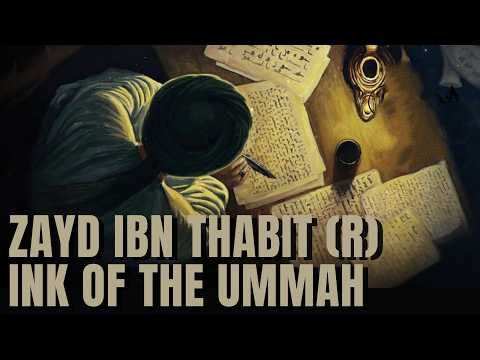
From that young age he served as one of the principal scribes of revelation and letters for the Messenger of Allāh ﷺ.
The Prophet ﷺ himself instructed him in the science of inheritance (ʿilm al-farāʾiḍ) and testified that he was the most knowledgeable of the Companions in that field.
He was first permitted to participate in military campaigns after he came of age, beginning with al-Khandaq when he was about fifteen.
After the death of the Prophet ﷺ, when Zayd was in his early twenties, Abū Bakr aṣ-Ṣiddīq charged him with the momentous project of collecting the Qurʾān into a single written compilation following the heavy losses of the ḥuffāẓ at Yamāmah. Zayd later described the difficulty of the task, saying that if he had been ordered to move a mountain it would not have been heavier upon him. With extraordinary precision and care he gathered the revelation from parchments, shoulder-blades, palm-leaf stalks, and the memories of the trustworthy, verifying every portion against multiple witnesses.
Under ʿUthmān ibn ʿAffān, when Zayd was in his thirties, he was again entrusted with the same sacred project: supervising the standardisation of the muṣḥaf from the ṣuḥuf preserved with Ḥafṣah, producing the authorised copies that were then distributed to the amṣār. The entire Ummah, from that day until the Day of Judgement, remains dependent upon the accuracy, dexterity, and integrity with which this young man—still in the prime of his life—discharged this dual trust in the eras of Abū Bakr and ʿUthmān.
He was known for his devotion to the Book of Allāh, his precision in transmission, and his service as a judge and advisor in Madīnah. He left no authored books in the later sense, yet his rulings in inheritance and his transmission of the Qurʾān and Sunnah formed a foundational pillar for the fiqh of Madīnah.
Among those who took knowledge from him were many of the senior Tābiʿīn, including Saʿīd ibn al-Musayyib, ʿUrwah ibn az-Zubayr, and his own son Khārijah ibn Zayd (who is himself named later by an-Nasāʾī among the Tābiʿīn of Madīnah). Companions such as Ibn ʿAbbās, Abū Hurayrah, and Ibn ʿUmar also narrated from him.
Among the most notable reports concerning him is the statement of Ibn ʿAbbās at his funeral: that a great portion of knowledge had departed with him. Abū Hurayrah is also reported to have said upon his death that the scholar of this Ummah had passed away.
He died in Madīnah in the year 45 AH at the age of approximately fifty-six (the most widely accepted date and age among the early authorities), during the caliphate of Muʿāwiyah, and was buried there.
May Allāh unite us with him in the Firdaws, āmīn
(Named by an-Nasāʾī immediately after ʿUmar among the fuqahāʾ of Madīnah from the Companions.).