Britain’s Campaign to Extinguish Muslim Dominance in Egypt, Sudan, and Nigeria
The British advance into Muslim Africa was never merely a matter of trade routes or strategic outposts. It was a calculated project to break the political power of Islām, confine the Sharī‘ah to the private sphere, and replace the possibility of Muslim self-rule with Western constitutions, secular administration, and a civilisation oriented toward Europe. In Egypt, Sudan, and Northern Nigeria, the pattern was consistent: military conquest where necessary, the subordination or selective reshaping of Islamic institutions, the cultivation of Westernised elites, and the permanent alteration of the legal and educational order so that a return to comprehensive Sharī‘ah governance would become nearly impossible.
In Egypt the decisive blow fell in 1882. After the ‘Urābī revolt, British forces occupied the country and installed a system of veiled protectorate under which real authority rested with the British Agent and Consul-General. Lord Cromer, who dominated Egyptian affairs from 1883 to 1907, made no secret of his civilisational hierarchy. He regarded full “Egypt for the Egyptians” under the existing leadership as impossible and saw British rule as the instrument for the gradual introduction of European civilisation. The Sharī‘ah was restricted largely to matters of personal status—marriage, inheritance, and endowment—while criminal, commercial, and public law were placed under secular codes and mixed courts dominated by European principles. British advisers sat in the ministries; Egyptian ministers were expected to follow their guidance. Education policy deliberately limited the expansion of higher learning that might produce an independent, assertive Muslim intelligentsia.
The result was an administrative and legal order in which the comprehensive claims of the Sharī‘ah were permanently sidelined in favour of a Western constitutional framework.
Sudan presented an even clearer case of the destruction of an Islamic state. The Mahdist movement had established a polity that sought to govern by a purified Islamic order and that had expelled Turco-Egyptian rule.
The British reconquest culminated in the Battle of Omdurman (Karari) on 2 September 1898. Anglo-Egyptian forces under Kitchener, armed with modern rifles and machine guns, annihilated the Mahdist army. Contemporary estimates place Mahdist dead at approximately 11,000, with thousands more wounded, against fewer than fifty British and Egyptian fatalities. After the battle there were reports of summary executions and the desecration of the Mahdi’s remains.
The victorious power then organised the Anglo-Egyptian Condominium, in practice a British colony. The new administration presented itself as the defender of “orthodox” Islām against Mahdist “heterodoxy,” yet its deeper purpose was to prevent any recurrence of an independent Islamic state. Sharī‘ah courts were retained under strict supervision and largely confined to personal matters; public authority, finance, and the military remained under British control. The educational and administrative structures that followed oriented the northern Sudanese elite toward Western models and away from the political vision of the Mahdiyya.
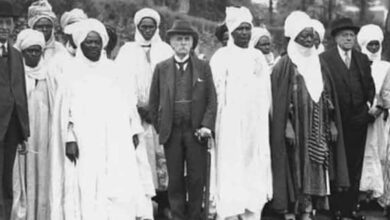
In Northern Nigeria the method was subtler but no less transformative. After the conquest of the Sokoto Caliphate and related emirates in the early years of the twentieth century, Frederick Lugard instituted the system of indirect rule. Emirs were retained as Native Authorities, and Islamic law was allowed to operate in the personal and, to a limited extent, the criminal sphere—yet always under the overriding authority of the colonial Resident and the principles of British “good order.” Certain classical provisions, such as the full operation of diyya (blood-money) as an interpersonal right, were progressively curtailed or subordinated to the state’s monopoly on legitimate violence.
The colonial power guaranteed that it would not interfere with the “Mohammedan religion,” yet it redefined the constitutional balance between political and scholarly authority so that the emirs became agents of the colonial state rather than independent upholders of a Sharī‘ah order.
Western education was introduced selectively; missionary activity in the Muslim North was restricted for reasons of political prudence, but the long-term effect was still the creation of an elite familiar with British administrative and constitutional forms. When the Northern and Southern Protectorates were amalgamated in 1914, the framework of a future Nigerian state was set on foundations that privileged Western constitutionalism over any restored caliphal or emirate model of Islamic governance.
Across these three theatres the British objective was consistent. Islamic political dominance was to be ended—by battlefield annihilation in Sudan, by occupation and legal restriction in Egypt, and by incorporation and subordination in Northern Nigeria.
The Sharī‘ah was not always abolished outright; it was contained, reshaped, and rendered subordinate so that it could no longer serve as the comprehensive constitution of a sovereign Muslim polity. In its place came Western codes, secular courts, English-language education, and constitutions modelled on European lines. The Muslim societies that emerged from colonial rule were thus predisposed toward political systems, legal assumptions, and civilisational reference points that looked West rather than toward the classical order of the Sharī‘ah.
This is the British record in Muslim Africa. The massacres of Omdurman, the veiled protectorate in Egypt, and the carefully managed indirect rule of the Nigerian emirates were not isolated episodes of conquest.
They formed part of a longer project to ensure that the political supremacy of Islām and the comprehensive application of its law would not return. The constitutions, educational systems, and elite orientations that remain in these lands continue to bear the imprint of that design. Remind them of this history.
Bārakallāhu Fīkum