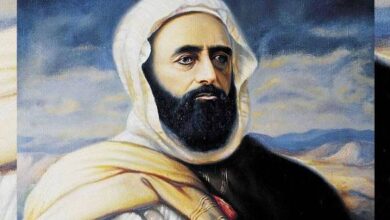
The Mujaddid al-Ḥājj ʿUmar ibn Saʿīd al-Fūtī: Scholar, Khalīfa, and Warrior of the Tijāniyya
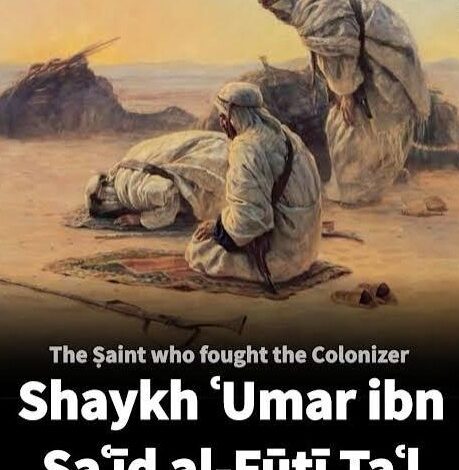
In the thirteenth century after the Hijrah, as European pressure mounted on the western coasts of Africa and internal weakness afflicted many Muslim polities, Allāh raised a figure who combined deep scholarship, Sufi authority, and the sword of jihād. Al-Ḥājj ʿUmar ibn Saʿīd al-Fūtī al-Tūrī (c. 1794/1797–1864 CE), known across West Africa as al-Ḥājj ʿUmar Tāl, stands among the great mujaddidūn of the Sudanic lands. Born in Halwar in Futa Toro (present-day Senegal) to a family of Torodbe scholars, he memorised the Qur’ān, mastered the Shar’ī sciences, and was drawn early to the spiritual path. His life would bind together the intellectual legacy of the earlier jihads, the rising Tijāniyya order, and a vast military enterprise that reshaped the western Sudan.
The turning point of his career was the Ḥajj. Between 1828 and 1830 he reached the Ḥijāz, studied, and was received by Sīdī Muḥammad al-Ghālī, a leading inheritor of Shaykh Aḥmad al-Tijānī. In a visionary encounter in the Prophet’s Mosque, al-Tijānī is reported to have confirmed ʿUmar’s full authorisation. He returned to West Africa as khalīfa of the Tijāniyya for the Bilād al-Sūdān, bearing a spiritual authority rare in his generation. On his homeward journey he spent years in Sokoto at the court of Muḥammad Bello, married into the ruling family, observed the administrative and military methods of the Sokoto Caliphate, and deepened his scholarly formation. He also visited Bornu. These years linked him to the reformist tradition of Shaykh ʿUthmān dan Fodio while rooting him firmly in the Tijānī path.
Upon returning to the west, Imām ʿUmar first established himself as a teacher and author. His magnum opus, Kitāb Rimāḥ Ḥizb al-Raḥīm ʿalā Nuḥūr Ḥizb al-Rajīm (“The Lances of the Party of the Merciful against the Throats of the Party of the Accursed”), completed around 1845, is a vast compendium of Tijānī doctrine, Sufi metaphysics, legal discussions, and spiritual counsel. In it he articulated the superiority of realised spiritual knowledge, the rank of the khalīfa, and the obligation to revive the Dīn. He wrote of his own station with clarity: that he was in Allāh’s service, holding fast to the Sunnah, and one of the heirs of the Prophet. The Rimāḥ became one of the most widely copied and influential works of nineteenth-century West African Islam.
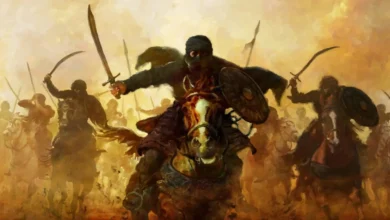
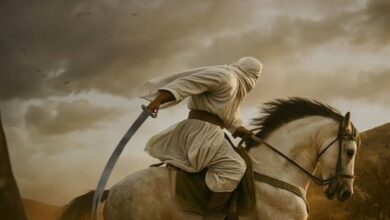
By the late 1840s Imām ʿUmar had gathered a community at Dinguiraye, on the edges of Futa Jallon. There he trained disciples, accumulated arms, and prepared for the greater struggle. In 1852–1853, after conflict with the non-Muslim rulers of Tamba, he proclaimed jihād. The movement rapidly expanded. His forces, stiffened by Tijānī talibés from Futa Toro and Futa Jallon and equipped in part with firearms obtained through trade, swept through the upper Senegal and into the Bambara kingdoms. He conquered Kaarta, then after prolonged campaigns took Segu (1861). His stated aims were the destruction of pagan power, the correction of Muslims who had mixed the faith with Kufr practices, and the establishment of a polity ordered by the Sharī‘ah under Tijānī spiritual authority. He clashed with the French on the Senegal River, recognising in their advance a mortal threat to Muslim independence.
The final phase of his career brought him into conflict with the Muslim Fulani state of Masina (Hamdullahi). Accusing its rulers of having aided the Bambara against the jihād and of religious deviation, ʿUmar invaded in 1862, captured the capital, and sought to impose his order. A fierce counter-revolt, supported by the Kunta scholars of Timbuktu, erupted. In February 1864, while besieged in the cliffs near Degembere, al-Ḥājj ʿUmar met his Shahādah. Tradition holds that the cave in which he had taken refuge was blown up with gunpowder. His son Aḥmadu Seku inherited a fractured empire that continued for decades before falling to the French.
Al-Ḥājj ʿUmar’s jihād was both external and internal. He fought Mushrikūn and expanding European power; he also confronted Muslim regimes he judged corrupt or compromised. His conception of renewal joined the greater jihād against the nafs with the lesser jihād of the sword. Through the Tijāniyya he spread a disciplined, activist Sufism that emphasised adherence to the Sharī‘ah, love of the Prophet, and loyalty to the spiritual hierarchy. The order he strengthened became one of the dominant forces in West African Islam, capable of both resistance and deep social penetration.
The lessons of his life are plain. Scholarship and spiritual authority, when joined to organisational power and military resolve, can alter the map of the Muslim world. The Ḥajj and the baraka of the awliyā’ can confer a legitimacy that no local pedigree alone provides. Jihād in defence of the Dīn and against both unbelief and internal decay remains an obligation when the conditions are met. At the same time, the costs of expansion—inter-Muslim conflict, the difficulties of governing diverse populations, and the rising pressure of European colonialism—reveal the limits of even the most gifted leadership.
Al-Ḥājj ʿUmar left behind a scholarly monument in the Rimāḥ, a spiritual network that outlived his empire, and a memory of resistance that later generations would invoke.
He died as he had lived: in the path of struggle for the elevation of the Word of Allāh.
May Allāh have mercy upon him, accept his jihād, and raise his rank among the renewers of the Dīn in the lands of the Sudan. Āmīn
Bārakallāhu fīkum.