Imām ʿUmar al-Mukhtār: The Lion of the Desert and the Steadfast Teacher of Jihād
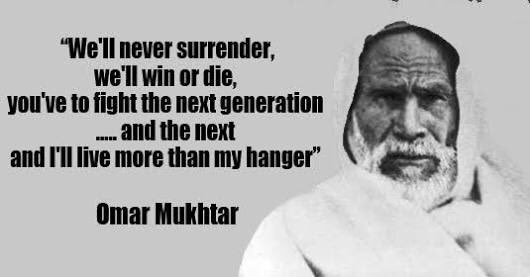
In the early decades of the fourteenth century after the Hijrah, as European powers completed their partition of the Muslim lands of North Africa, the Italian kingdom set its sights upon Libya. What began as an invasion in 1911 became, under Fascist rule, a systematic campaign of conquest, concentration camps, and cultural domination. Against this onslaught rose a Qur’ān teacher of the Sanūsiyya, already advanced in years, whose name would become a byword for unyielding resistance: Imām ʿUmar al-Mukhtār Muḥammad bin Farḥāt al-Manīfī (c. 1858–1931 CE), known to his people as the Lion of the Desert and to the wider Ummah as a symbol of dignified jihād against Western occupation.
Born in the region of Cyrenaica (Barqa) in eastern Libya, ʿUmar al-Mukhtār grew up within the spiritual and educational network of the Sanūsiyya order. He spent years studying at the zāwiya of Jaghbūb, the Sanūsī centre of learning, mastering the Qur’ān, the religious sciences, and the discipline of the path. He later served as a teacher and administrator of zāwiyas, forming the character of the young and preserving the Islamic identity of the tribes of the Green Mountain (al-Jabal al-Akhḍar) and the surrounding deserts. His early life was one of knowledge and quiet service; the Italian invasion of 1911 transformed it into a life of continuous struggle.
From the first landings, ʿUmar al-Mukhtār took part in the resistance. After the Fascist regime under Mussolini repudiated earlier agreements and launched a full-scale reconquest of Cyrenaica in 1923, he emerged as the principal military and spiritual leader of the mujāhidīn. Already in his sixties, white-bearded and of modest stature, he organised mobile guerrilla bands that struck Italian outposts, ambushed columns, and then melted back into the terrain they knew intimately. Italian officers themselves acknowledged his tactical skill, his ability to coordinate rival tribal groups, and his uncompromising character. General Rodolfo Graziani, his chief adversary, later described him as a man of quick intelligence, energetic and impetuous, unselfish and uncompromising, who remained very religious and poor even while holding one of the most important positions in the Sanūsī hierarchy.
The Italian response was of escalating brutality. Concentration camps were established; the population of the Jabal was subjected to mass internment, famine, and collective punishment. Barbed-wire barriers were erected along the Egyptian border to cut supply lines. Aircraft bombed the mujāhidīn and the civilian camps. Yet for nearly a decade ʿUmar al-Mukhtār continued the fight. When asked by Graziani after his capture why he fought the Italian government, he answered simply: “To defend my religion and my homeland.” When pressed about his goal, he replied: “Nowhere, except to drive you out, for you have violated our land. Combat has been prescribed for us, and only Allāh grants victory.”
On 11 September 1931 the elderly leader was wounded and captured in an ambush near Wadi Bu Taga. Brought before a military court in Benghazi, he faced the proceedings with calm dignity. Sentenced to death, he received the verdict with the words of the Qur’ān: “Innā lillāhi wa innā ilayhi rājiʿūn” — “To Allāh we belong and to Him we shall return.” On the morning of 16 September 1931, at the concentration camp of Suluq (Solluq), he was hanged before some twenty thousand Libyans whom the Italians had forced to witness the execution. He was approximately seventy-three years old. The colonial authorities hoped that his death would extinguish the resistance. In the short term the organised guerrilla war was broken; in the longer term his martyrdom planted a seed of memory that no occupation could uproot.
About his martyrdom, Ahmad Shawqī rahimahullāh said:
رَكَزوا رُفاتَكَ في الرِمالِ لِواءَ
يَستَنهِضُ الوادي صَباحَ مَساءَ
يا وَيحَهُم نَصَبوا مَناراً مِن دَمٍ
توحي إِلى جيلِ الغَدِ البَغضاءَ
“They planted your remains in the sands as a banner
that rouses the valley morning and evening
Woe to them! They raised a beacon of blood
that inspires hatred in the generation of tomorrow.”)
ʿUmar al-Mukhtār’s resistance was not merely military. It was a refusal of the entire Western colonial project that sought to reduce Muslim societies to dependencies, to replace their laws with foreign codes, their language with the language of the occupier, and their religious orientation with secular or Christianising influences. As a teacher of the Qur’ān and a Sanūsī shaykh, he understood that the defence of the land was inseparable from the defence of the Dīn. His jihād was waged under the banner of the Sharīʿah and the spiritual authority of the Sanūsiyya, against an enemy that employed modern technology, collective punishment, and cultural arrogance. In this he stands in the same line as ʿAbd al-Qādir al-Jazāʾirī in Algeria, al-Ḥājj ʿUmar al-Fūtī in the western Sudan, and the other mujāhidūn who refused to surrender the lands of Islam to European domination.
The ending of his earthly life was not an end to his witness. His steadfastness under interrogation, his refusal to bargain away principle for personal safety, and his final affirmation of the Qur’ānic truth have continued to inspire successive generations. In an age when the Ummah faces renewed forms of occupation, cultural erasure, and ideological pressure, the example of ʿUmar al-Mukhtār remains urgently relevant. The Ummah today stands in need of men and women of his likeness: scholars who do not separate knowledge from action; teachers who are prepared to lead in the field; leaders who prefer death with dignity to life under humiliation; and believers who understand that the defence of Muslim lands and the preservation of Islamic identity are obligations that do not expire with the changing of colonial flags.
The Lion of the Desert did not live to see the formal independence of Libya, yet his blood and the blood of those who fought under his command watered the ground from which later resistance would grow. His life proclaims that numerical and technological inferiority does not nullify the duty of jihād when the conditions are present; that age is no barrier to striving in the path of Allāh; and that a single steadfast heart, anchored in the Qur’ān and the fear of Allāh alone, can hold an empire at bay for years and leave a legacy that outlasts the gallows.
May Allāh have mercy upon Imām ʿUmar al-Mukhtār, accept his long jihād, his patience, and his martyrdom, and raise his rank among the truthful and the steadfast. May He grant the Ummah in every age men of his sincerity, his courage, and his unbroken attachment to the Dīn, so that the banner of resistance to oppression and Westernisation is never laid down.
Āmīn.
Bārakallāhu fīkum.