Administration and Education in the Khilāfah of Shaykh Uthmān Dan Fodio
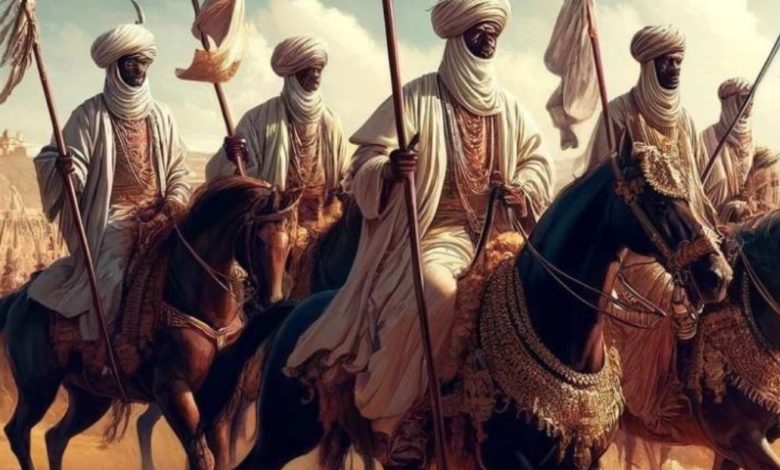
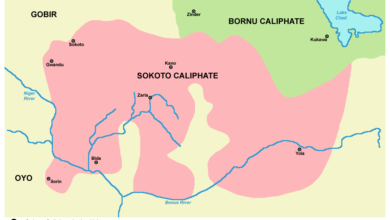
With the major campaigns concluded and the authority of the Sharīʿah established over a wide territory, the work of tajdīd entered a new stage. Victory in the field was not the end; it was the opening for the deeper task of ordering society according to the revelation, raising a generation upon knowledge, and producing a literature that would guide rulers and ruled alike. Shaykh ʿUthmān, his brother ʿAbdullāh, and his son Muḥammad Bello turned their attention to this labour with the same seriousness they had shown in the years of teaching and in the years of Jihād.
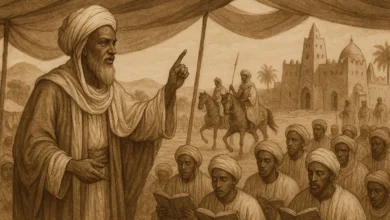
Shaykh ʿUthmān himself withdrew increasingly from the day-to-day administration. He settled for a time at Sifawa and later near Sokoto, where he continued to teach, to write, and to receive those who came seeking guidance. His later works address the responsibilities of the ruler, the rights of the subjects, the dangers of worldly attachment after victory, and the necessity of remaining upon the Sunnah. He warned the new emirs against the very injustices that had characterised the old Hausa courts — uncanonical taxes, the abuse of power, and the neglect of the scholars. The sword had opened the land; the pen and the lesson-circle were to secure it.
ʿAbdullāh ibn Fūdī, now established at Gwandu as the ruler of the western provinces, produced some of the most important legal and political writings of the age. His Ḍiyāʾ al-Ḥukkām is a manual for governors and judges, setting out the rulings they must know and the conduct required of them. In it he draws upon the Mālikī tradition while keeping the Qur’ān and the authentic Sunnah as the final measure. His Tazyīn al-Waraqāt preserves the history of the early years and the poetry of the struggle, ensuring that the community would not forget the path by which Allāh had granted them success. ʿAbdullāh was both a ruler and a teacher; the court at Gwandu remained a place of learning as much as a place of governance.
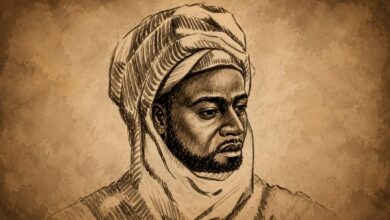
Muḥammad Bello, who bore the heavier burden of administering the eastern heartlands and later succeeded his father as Amīr al-Muʾminīn, combined military consolidation with an extraordinary literary output. His Infāq al-Maysūr is the principal chronicle of the Jihād and the early Caliphate, written with the care of a historian who had lived the events. Beyond history, he composed works on governance, on medicine, on the virtues of knowledge, and on the spiritual discipline required of those in authority. Under his direction the city of Sokoto became a centre to which students travelled from distant regions. The emirs he appointed were expected to be men of learning or to keep scholars close to them. The judicial system was organised so that the qāḍīs ruled by the Sharīʿah, and the collection of zakāh and the other canonical dues replaced the arbitrary exactions of the past.
Education was not left to chance. The Fodiawa established and supported circles of learning in the major towns. The Qur’ān was the foundation; thereafter the students progressed through Arabic grammar, fiqh, ḥadīth, tafsīr, and the other sciences. Women of the household of Shaykh ʿUthmān, most notably his daughter Asmāʾu, also participated in the transmission of knowledge, composing works in Fulfulde and Hausa that carried the teachings of the tajdīd to those who did not read Arabic. The result was a society in which literacy in the religious sciences spread more widely than before, and in which the authority of the ʿulamāʾ was woven into the structure of the state.
The civilisation that emerged was one ordered by the Sharīʿah. Markets were regulated, the ḥudūd were applied with the conditions required by the law, hospitality to travellers and students was encouraged, and the caravan routes that passed through the Caliphate enjoyed a greater measure of security. The Fodiawa did not merely conquer; they sought to transform. They wrote against the remnants of pre-Islamic custom, against the excesses that can follow military success, and against any return to the arbitrary rule of the past. Their literature — running to hundreds of works in Arabic, and many more in the local languages — remains the clearest witness to their intentions.
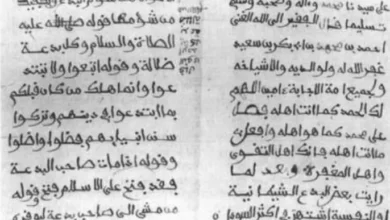
The sources for this period are abundant and internal. The writings of Shaykh ʿUthmān, the legal and historical works of ʿAbdullāh, and the chronicles and treatises of Muḥammad Bello form a continuous record produced by the very men who shaped the state. Later scholars of the Caliphate continued to copy, comment upon, and teach these texts, ensuring that the intellectual project of the tajdīd outlived its founders.
The lesson of these years is that the establishment of the Sharīʿah does not end with the defeat of its opponents. It requires the patient labour of teaching, the production of sound knowledge, the training of judges and administrators, and the constant reminder that power is a trust. Shaykh ʿUthmān and those with him understood that a community victorious in battle can still lose its way if it neglects knowledge and the purification of intention. They therefore gave to the pen and the lesson-circle a place no less central than the place they had given to the sword.
May Allāh have mercy upon Shaykh ʿUthmān ibn Fūdī, upon ʿAbdullāh, and upon Muḥammad Bello. May He accept the knowledge they spread, the institutions they established, and the literature they left for those who came after them, and may He grant this Ummah leaders who build upon victory with the same care with which they sought it.
Bārakallāhu fīkum.