The Establishment of the Sokoto Caliphate
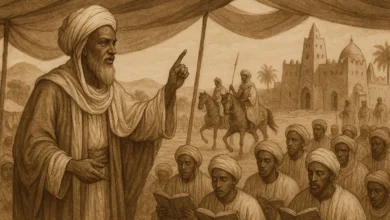
The years of patient teaching and the formation of the jamāʿah could not continue indefinitely under the increasing hostility of the rulers of Gobir. Yunfa, who had once sat in the circles of Shaykh ʿUthmān, now sought to break the community. He forbade the public teaching, harassed the followers, and finally moved against them with open force. In the face of this oppression, Shaykh ʿUthmān ordered the hijra. In Dhū al-Qaʿdah 1218 AH (February 1804) the jamāʿah left Degel and made its way to Gudu, a place beyond the effective reach of the Gobir authorities. There the companions gathered around him and gave him the bayʿah as Amīr al-Muʾminīn.
The first to pledge allegiance was his brother ʿAbdullāh, followed by his son Muḥammad Bello and the rest of the community. With that pledge the obligation of Jihād became clear, for the land had become a place in which the Sharīʿah could no longer be established under the existing rulers.
Shaykh ʿUthmān composed Bayān Wujūb al-Hijra ʿalā al-ʿIbād in these critical months. In it he set out the legal and religious foundations for the emigration and for the struggle that followed. He explained the conditions under which hijra becomes obligatory, the distinction between the land of Islam and the land of unbelief, and the duty of the Muslims to establish the rule of Allāh when they are able. The work is not a call to chaos; it is a careful exposition rooted in the Qur’ān, the Sunnah, and the statements of the earlier ʿulamāʾ, showing that the path taken by the jamāʿah was the path of the Prophet ﷺ himself.
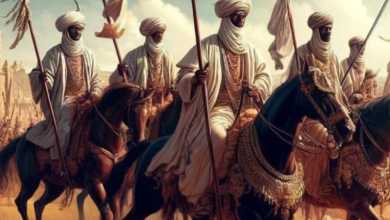
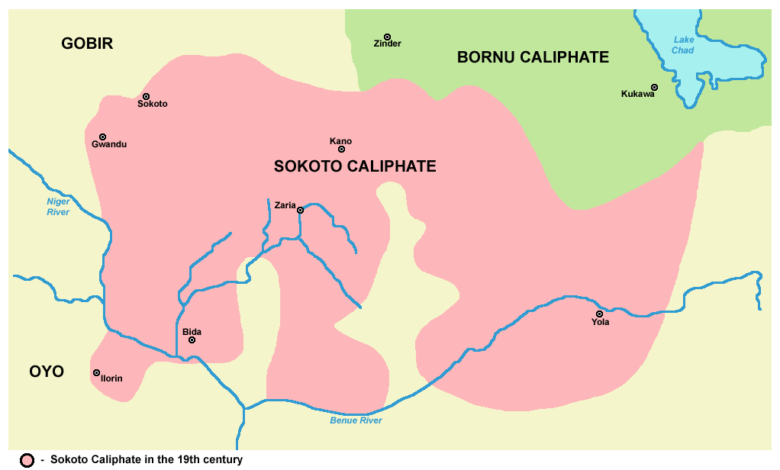
The first major encounter came at Tabkin Kwotto. The forces of Gobir, confident in their numbers and their cavalry, met the army of the Muslims. Under the command of ʿAbdullāh and with the spiritual authority of Shaykh ʿUthmān behind them, the jamāʿah stood firm and inflicted a decisive defeat upon the enemy. That victory opened the way. From Gudu the movement spread. One after another the Hausa states fell or submitted as the call of the Sharīʿah reached their people and as the armies of the mujāhidūn advanced. Kano, Katsina, Zazzau, and others came under the new order.
In 1808 the capital of Gobir, Alkalawa, was taken, and Yunfa met his end. The long oppression of the Muslims in that land was broken.
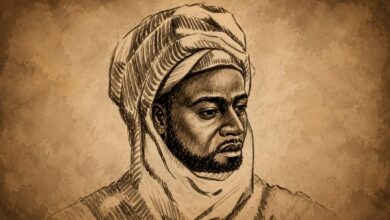
Throughout these campaigns Shaykh ʿUthmān remained the source of authority and guidance, yet he did not lead every army in person. He entrusted the military and administrative responsibilities to those he had trained. His brother ʿAbdullāh became the commander of the western forces and later the ruler of Gwandu. His son Muḥammad Bello took charge of the eastern campaigns and the consolidation of the heartlands that would become Sokoto. Both were scholars before they were commanders. Both wrote, taught, and judged according to the Sharīʿah even while the battles continued. The Jihād was never separated from the Daʿwah; the sword served the Book, and the victories were understood as the opening of Allāh for the establishment of His law.
By the time the major fighting subsided, a new polity had come into being. Shaykh ʿUthmān was recognised as Amīr al-Muʾminīn over a vast territory. He divided the administration: the west under ʿAbdullāh, the east under Muḥammad Bello, while he himself withdrew increasingly to teaching, writing, and the spiritual direction of the community. The Caliphate that emerged was not a mere replacement of one set of rulers by another. It was an attempt to order society according to the revelation — with the appointment of emirs known for knowledge and piety, the establishment of judges who ruled by the Sharīʿah, the collection of the canonical taxes, and the suppression of the uncanonical exactions that had characterised the previous regimes.
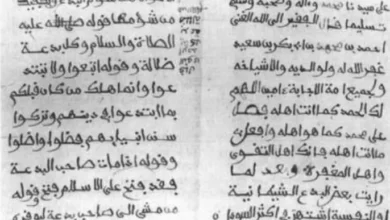
The record of these years is preserved in the writings of the Fodiawa themselves. Bayān Wujūb al-Hijra lays out the legal case. ʿAbdullāh’s Tazyīn al-Waraqāt and his later historical and legal works describe the events from the perspective of one who lived them. Muḥammad Bello’s Infāq al-Maysūr provides a detailed chronicle of the campaigns and the early organisation of the state. Together these texts show that the Jihād was the fruit of long preparation, that it was conducted with a clear legal and moral purpose, and that its leaders never ceased to be ʿulamāʾ even in the midst of war.
The lesson of this stage is that when the Daʿwah has been established, when the jamāʿah has been formed, and when the rulers persist in obstructing the Sharīʿah, the obligation of standing for the Dīn may become unavoidable. Shaykh ʿUthmān did not seek confrontation for its own sake. He sought the freedom to teach and to live by the revelation. When that freedom was denied and the community was attacked, he made the hijra and then the Jihād, following the pattern of the Prophet ﷺ. The victories that followed were not the result of superior numbers or weapons alone; they were the result of a community that had been prepared in knowledge, in sincerity, and in the willingness to sacrifice for the sake of Allāh.
May Allāh have mercy upon Shaykh ʿUthmān ibn Fūdī, upon his brother ʿAbdullāh, and upon his son Muḥammad Bello. May He accept their Jihād, their governance, and their continued teaching, and may He raise their ranks among those who established the Dīn in the land.
Bārakallāhu fīkum.